
Reading Fragrance Case Studies as Process Evidence for a Haircare Line
A manufacturer's case studies are the cheapest process audit you can run before you pay for a plant visit. Each published project shows how the company sequences development, which formats it can handle and how much work happens under one roof — if you read it as process evidence. For a haircare line, where the fragrance has to survive a shampoo or conditioner base, those process clues matter more than the pictures.
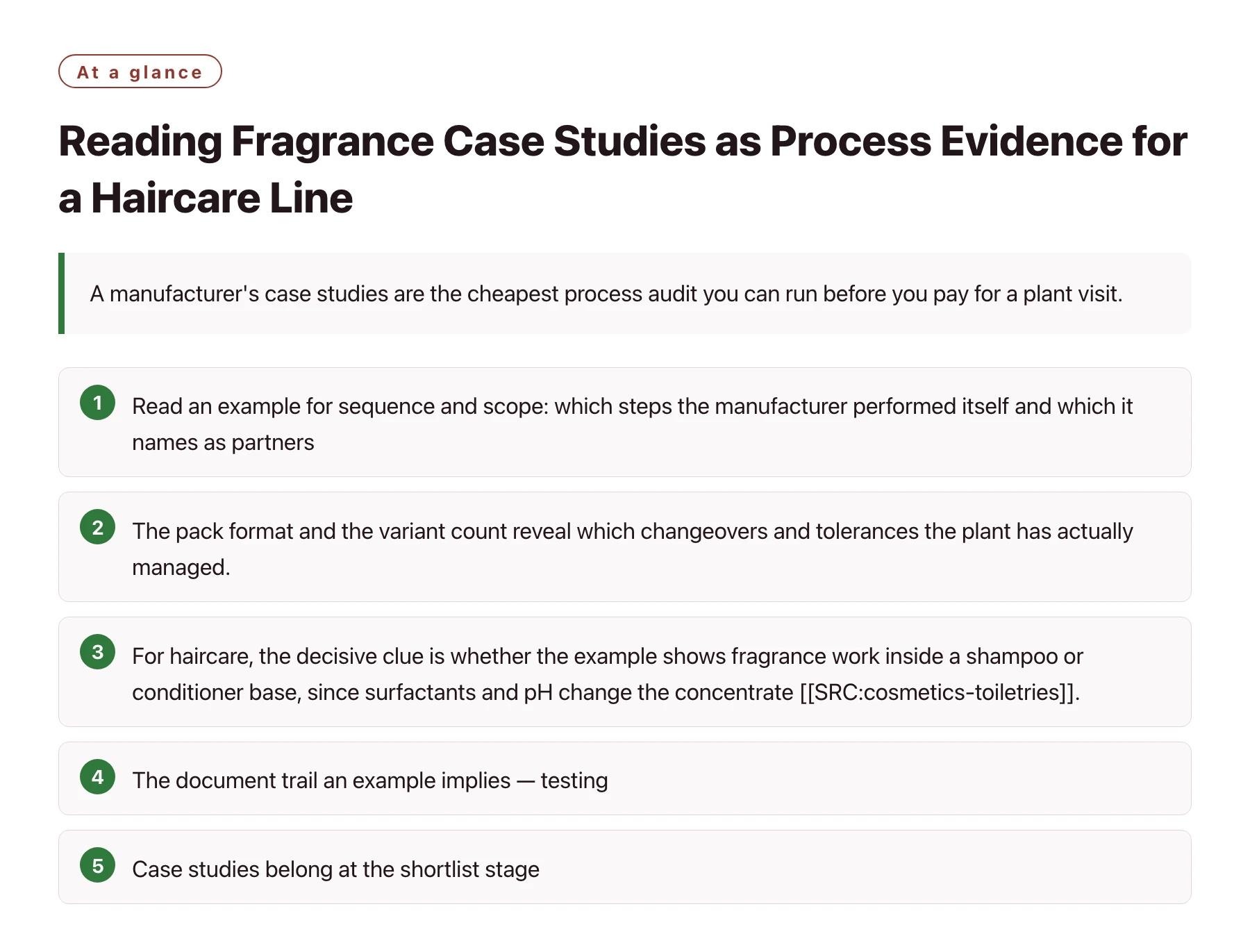
Key takeaways
- Read an example for sequence and scope: which steps the manufacturer performed itself and which it names as partners, because that is the shape of your own project.
- The pack format and the variant count reveal which changeovers and tolerances the plant has actually managed.
- For haircare, the decisive clue is whether the example shows fragrance work inside a shampoo or conditioner base, since surfactants and pH change the concentrate [1].
- The document trail an example implies — testing, stability, market files — tells you which process stages the supplier treats as routine.
- Case studies belong at the shortlist stage; verification belongs after it, when the reconstruction can be checked against a live batch record [2].
Buyers read case studies for proof of capability and usually come away with a portfolio. The gap is method: a project example is a finished story, and the manufacturing process is the grammar underneath it.
This is a method for reading that grammar back out — reconstructing the step-by-step process behind a published example — written for a brand developing a scented haircare line.
What an example does and does not show
A published example verifiably shows the product category, the pack format, the decoration level, the number of variants and often the served markets. It cannot show batch sizes, lead times, tooling ownership or the testing behind the release, because those are negotiated, not published.
The useful read treats the visible details as process markers: each one constrains what the manufacturer must have done to produce that result.
Sequence is the first thing to look for
Does the example describe development before sampling, and sampling before bulk? A portfolio organised around stages — brief, formulation, packaging, filling — reveals the process. One organised purely around finished products reveals what the company would rather sell you.
Scope is the second
Which steps are described as in house and which mention partners or suppliers? Fragrance development, bottle and packaging design, filling and packing can sit under one roof or across several companies, and the example usually names the arrangement indirectly.
Reconstructing the process in six steps
- Name the category and the baseIs it a fine fragrance, a haircare product, a home fragrance? The category decides which development stages had to happen — in haircare, the base work is most of it.
- List the componentsBottle, closure, pump, label, carton. Every component implies a sourcing and quality step, and an unusual component implies tooling.
- Count the variantsEach extra scent or format multiplies changeovers, references and release documents. A wide range implies disciplined changeover routines; a single SKU proves very little.
- Map the stages to a process shapeMatch what you listed onto the standard stages — brief, formulation, stability, tooling, filling, release. The gaps are the questions to ask.
- Ask for the same sequence in a batch recordThe reconstruction is a hypothesis until the plant shows one completed batch record, from raw material intake to release, that matches the shape.
- Check the scope against your own projectIf your haircare line needs fragrance stability work in a surfactant base and the example shows none, that is a gap in capability or in honesty — either way, it goes to the top of the question list.
The process clues in a published example
| Detail in the example | What it reveals about process | Question to follow up |
|---|---|---|
| Fine fragrance only | Little evidence of base chemistry work | Can you show a fragrance project inside a shampoo base? |
| Heavy decoration | The plant manages high-value components and reject rates | Who owns the mould, and what is the decoration minimum? |
| Many variants | Changeover and release discipline | How do you keep six scents from cross-contaminating on the line? |
| A named documentation step | Testing and release are treated as routine | Which laboratory ran the stability, and on which lot? |
| No mention of partners | Mostly in-house scope, or undisclosed | Can you list the steps you subcontract, in writing? |
The pattern is consistent: the more the example shows about stages and scope, the more the manufacturer is used to being audited on process. The more it shows finished bottles, the more the process conversation will have to be extracted.
What is different when the line is haircare
Haircare changes the process before it changes the scent. A concentrate that performs in alcohol does not automatically perform in a shampoo base, because surfactants, pH and the wash cycle strip and re-deposit fragrance differently. The stability work is therefore not a footnote; it is a core stage [1].
That also changes what the case studies should contain. Examples of fine fragrance tell you the manufacturer can compound, fill and decorate; they tell you little about emulsion or gel work. If a haircare line is the goal, ask directly for examples of fragrance inside a shampoo, conditioner or leave-in mist, and read the answers with the same sequence and scope lens.
One useful habit is to bring the reconstruction to the first call. A buyer who shows a supplier the process shape they inferred — and asks where it is wrong — gets a much more specific conversation than a buyer who asks for a catalogue. Mapping the visible details onto the standard stages of the stages of perfume production is the fastest way to see which part of your project an example actually covers.
Manufacturers publish project examples precisely so buyers can do this, and a page of Xuelei case studies is a reasonable place to start practising the read. A partner that develops from a brief and produces end to end, such as one offering bespoke fragrance development and production, will usually answer the scope questions in the same meeting.
A case study is a hypothesis about process, and a batch record is the evidence. Bring the hypothesis to the shortlist call, ask the supplier to confirm or correct it, then verify on one completed record from intake to release. The reconstruction is what makes the plant visit a verification instead of a tour.
Sources
- Cosmetics & Toiletries —— A technical magazine for cosmetic formulators, covering ingredients, formulation science and testing methods.
- SGS: Cosmetics, Personal Care & Household Testing —— Testing, inspection and certification services for cosmetics and personal care, including microbiological, stability and safety testing aligned with cosmetics GMP.
Frequently asked questions
Can I judge a manufacturer's process from its website alone?
You can build a strong hypothesis: category, scope, variant handling and decoration route are visible in most portfolios. Verification still needs a batch record and a conversation, but the reading decides where to spend both.
Which single detail in a case study carries the most information?
The number of variants and formats. It is the most reliable visible signal of changeover discipline, reference management and release documentation, and it is the detail most buyers skip.
Why does a haircare fragrance need different process evidence?
A fine fragrance example shows compounding, filling and decoration, but the decisive work in haircare is the base: stability of the concentrate in surfactants and at the product's pH. Ask for fragrance-in-base examples; without them the evidence is about the wrong product.
What should I take from a case study to the first call?
Your reconstruction: the stages you inferred, the scope questions they raised, and the two or three gaps that matter for your project. Suppliers read that as a list of things to prove, which is the conversation you want.
How many examples should I read per supplier?
Three that resemble your category and pack format beat a long gallery. Read them for sequence and scope, then compare two suppliers' examples of the same product type — differences that remain are usually differences in process.
Ready to see the signal behind the numbers?
Pulsaf5 turns fragmented transaction, identity, and behavioral data into one real-time performance signal — shipped in days, not quarters.